
Golf and Tennis Injuries: 9 Ways to Improve Hip Function and Reduce Injury Risk
Robert Inesta
7/7/20267 min read
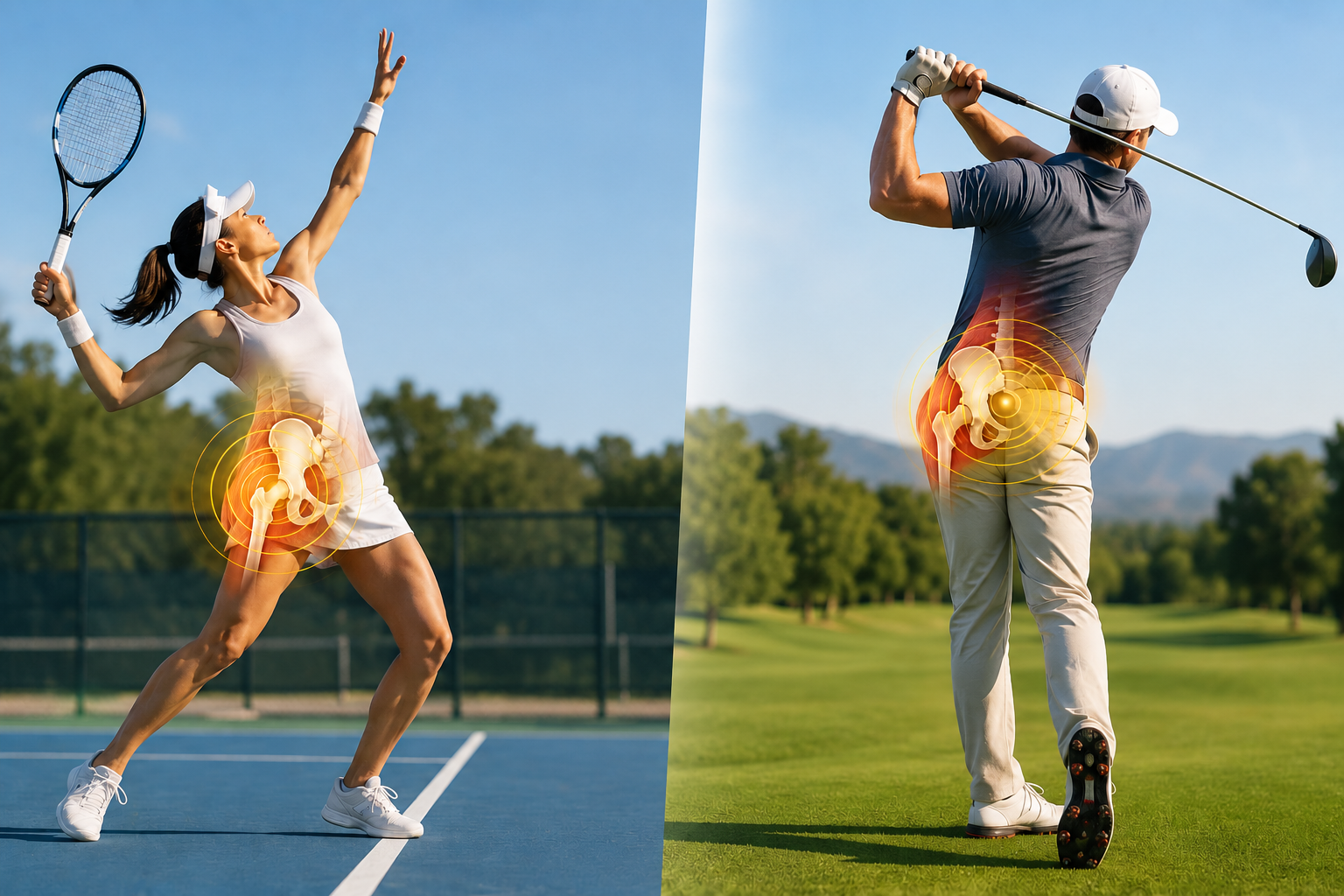
Healthy hip function is one of the most overlooked factors in preventing and treating golf and tennis injuries. By "hip function," I mean adequate mobility, especially rotation, along with proper muscle activation and coordination.
In my practice, this is one of the most consistent patterns I see among golfers, tennis players, pickleball players, and squash players dealing with repetitive strain injuries.
Restrictions in hip movement don't just affect the hips. They can contribute to increased stress on the shoulders, elbows, knees, and lower back because those areas often compensate when the hips aren't generating movement and power efficiently.
Some common issues that can be related to hip restriction are:
tennis elbow
golfers elbow
rotator cuff strains and other shoulder conditions
low back pain
knee pain
One of the great advantages to playing golf and tennis is that it’s possible to play well into the elder years. Movement is life and anything that can keep us moving, bring us joy, and even a little sense of competition, is a huge plus for our brains and overall health as we age. So in order to get the most out of our bodies, it’s important to understand how to minimize potential problems and damage that can prevent us from playing.
Whether you’re swinging a golf club, tennis racket, throwing a ball or even a punch, our main source of power comes from the muscles of the hips. In order to generate the appropriate amount of power and momentum, the hips need to move freely. So if there is restriction in the movement or if the muscles are not firing appropriately, there won’t be as much power generated.
When there’s less power coming from the hips, other areas will have to compensate and therefore do more work than they should be doing on a repetitive basis. This accumulates unnatural stress loads in these tissues, which over time, can lead to injury.
Think of the body as a chain of connected links. When one link doesn't move well, the neighboring links have to absorb more motion and force. After thousands of golf swings or tennis serves, those extra stresses begin to accumulate.
Let’s look at the common example of low back pain. There are many causes of lower back pain, such as disc injuries, muscle strains, spasms, joint sprains and irritation. Many times it’s a combination of multiple factors. After the pain or symptom generating tissue is determined, the question should always be “why is this happening?”
Examining the areas above and below the site of symptom is helpful in answering this question. When examining the hip, I often find limited internal rotation and hip extension, along with movement patterns that aren't as smooth or coordinated as they should be.
Because of these imbalances, it then causes stress in the areas above and below. In the case of the hip, the low back is above and the knee is below. Over time, these altered movement patterns can create tension and restriction within the fascia (connective tissue), placing additional stress on structures such as the sacroiliac joint, lumbar muscles, and spinal discs.
Another common pattern of hip dysfunction is upper extremity injuries in the shoulder and/or elbow.
When swinging a club or a racket, if the body is not properly coordinated, power is not coming from the hips, and core is not stabilized, the shoulder has to generate more of the force that should have originated from the hips. Eventually this can cause unnatural stress and tension leading to movement imbalances and injury.
To take it a step further, if the shoulder is accumulating unnatural tension, it can become restricted in movement without manifesting pain. This restriction can then lead to unnatural stress in the elbow, the next joint below in the chain.
Over time, the muscles and tendons that attach around the elbow begin absorbing these extra forces. Eventually this may contribute to golfer's elbow or tennis elbow.
This is why I find myself working the hips in most cases of the above conditions or injuries.
The common culprits of hip dysfunction are:
Muscle weakness
Faulty coordination/muscle firing
Joint movement restriction due to soft tissue tension, adhesion/scar tissue, or degenerative arthritis
Of course it can be either one or a combination of the above factors.
These issues are often caused by faulty mechanics, poor posture, old injuries, trauma, and stress.
So now that we know what this common cause is, what do we do about it?
9 Ways to Keep Your Hips Healthy and Reduce Injury Risk
Here are nine ways to optimize and maintain hip function in order to minimize or prevent golf and tennis injuries.
Work with a Professional Instructor and Improve Form
Good form is essential not only to achieve the farthest drive or fastest serve, but also to minimize wear and tear on your body. Investing in lessons with a knowledgeable pro is a wise strategy to continue to improve your game and your body mechanics.
As with any skill, we don’t become masters overnight. It’s an ongoing process that takes instruction and practice over time. We often think of taking lessons when first learning to play and then we’re on our own. But lessons should be an ongoing thing to continually refine and improve your movements.
Balance Exercises
This is also known as proprioceptive, or neurosensory training. This type of training will help improve coordination and nerve-fascia-muscle communication and firing patterns.
Basic balance exercises are something everyone can benefit from and should be doing for general health. An example is a simple one leg standing exercise. But there are more sport specific exercises that either a pro instructor or functional trainer can help you implement.
Deep Squat
Squats are one of the most versatile and comprehensive exercises. For the purpose of this article, I’m referring to the squat as more of a mobilization/stretch technique as opposed to a strengthening exercise.
Sitting in a deep squat is a fantastic way to preserve and even improve hip mobility and knee mobility. This is great to do every day and especially before and after playing. Here’s an article on the squat that goes into more detail.
If you’re not able to go all the way down, don’t force it. Do what your body allows and slowly progress. It’s also best to do this near something like a countertop or sturdy chair you can use to help pull yourself up in case you have trouble.
Dynamic Stretching Before Playing
Dynamic stretching is stretching that involves movement. It’s great for mobilizing the soft tissues (muscles, fascia, ligaments, tendons) while activating the nervous system and increasing circulation. Think of it as priming the system for action. It’s always best to do this before working out or playing.
There’s a vast variety of dynamic stretching movements and techniques. Some simple examples are swinging one leg back and forth and side to side while standing, trunk rotations while letting your arms swing freely, and arm circles. Even jumping jacks and other calisthenics can be considered dynamic stretching because they’re lengthening the tissues through full ranges of motion while moving.
A pro instructor or functional trainer can help teach you more and even sports specific dynamic stretches.
Static Stretching After Playing
Static stretching is what we typically think of as classic stretching. It involves holding a pose or position in which a muscle or group of muscles is lengthened or stretched. The stretch is usually held for about 30-60 seconds. It’s called static stretching because you remain still, or static, once in the stretch position.
This type of stretching should always be done after playing or working out as part of the cool-down. Static stretching maintains and potentially increases flexibility and relaxes muscles.
Spend five to ten minutes static stretching after playing or working out. Keep the level of stretch tension comfortable. Don’t go too far to where you feel burning or discomfort. Hold positions for 30 - 60 seconds and then release.
Dynamic Movement (Different From Your Sport)
This refers to different, multidirectional movements or activities to help provide a variety of movement in addition to the repetitive motions of the sport. Some examples are dancing, yoga, and martial arts such as tai chi, karate, kickboxing.
This helps improve and maintain range of motion while helping neuromuscular coordination.
Hydration
The importance of proper hydration cannot be overstated. It’s involved in all aspects of physiology and health. Even mild dehydration can cause muscle cramping and fascial tension. When these tissues are tense, you are more likely to have strains, sprains, tears and even bone fractures.
One of the many functions of water in the musculoskeletal system is lubrication of the soft tissues and joints. Hyaluronic acid is a substance involved in lubricating the layers of fascia throughout the body. It does this by binding water in order to allow the tissues to slide freely over each other during movement. If dehydrated, the layers won’t move as easily affecting biomechanics and nervous system function.
There are different theories and guidelines about water intake, but not much research demonstrating what’s correct. One commonly suggested guideline is to take half your bodyweight in pounds and drink that number of ounces of water per day. So for example if you weigh 100 pounds, you’d drink 50 ounces of water per day.
A simple basic gauge is to check your urine color. It should be light pale yellow to clear. Dark urine is an indication of dehydration. And although clear urine can indicate good hydration, if your urine is always clear no matter how much water you’re drinking it may indicate other issues, so check with your doctor
Myofascial Work
Myofascial techniques such as Active Release Techniques (A.R.T.) and Stecco Fascial Manipulation help to release tension from the muscles and connective tissues (fascia, joint capsules, tendons, ligaments) and improve mobility and function.
Soft tissue dysfunction such as tight muscles, trigger points, fascial tension, and scar tissue adhesions can alter and restrict joint range of motion and neuromuscular function. This can inhibit the ability to move properly and to generate power when swinging a golf club or tennis racket.
The above techniques can allow a practitioner to specifically target areas of imbalance in order to restore normal function.
Acupuncture/Dry Needling
Acupuncture works on multiple levels. Firstly, it helps to regulate the nervous system and prime the healing process on a systemic, or whole body, level.
Acupuncture and dry needling can also be used to precisely release soft tissue tension, release trigger points, activate muscle motor points to improve firing patterns, and improve microcirculation for more efficient recovery.
In my practice, I combine the above myofascial techniques with chiropractic and acupuncture/dry needling for a comprehensive approach to neuromusculoskeletal conditions and pain.
Conclusion
The hip is often a key component in common tennis and golf injuries and repetitive strain conditions. Maintaining healthy hip mobility and function is essential to not only improving your game, but also to be able to play as long as possible with less risk of injury and pain.
Ideally, I recommend making these self care suggestions part of your regular routine and not just something you do after an injury develops. Spending 10 -15 minutes a day working on hip mobility and coordination can pay dividends for years.
If you’ve been dealing with stubborn injuries or pain, or are looking for help with preventing golf and tennis injuries in the Berkshires, I’d be happy to help. Contact us here to schedule an appointment.
Berkshire Functional Chiropractic & Acupuncture
FREE RESOURCES
info@berkshirefunctional.com
(413) 274-7161
© 2024. All rights reserved.